 Skip to content
If you’re thinking about learning digital marketing, one question naturally comes to mind:
“How long will it actually take?”
Not just to understand it — but to feel confident, apply it, and maybe even start earning from it. The problem is, most answers you find online are either too vague or too unrealistic.
Some say “you can learn in 30 days.” Others say “it takes years.”
The truth lies somewhere in between — and depends on how you learn, not just how long you learn. Let’s break it down honestly.
Table of Contents
ToggleQuick Answer
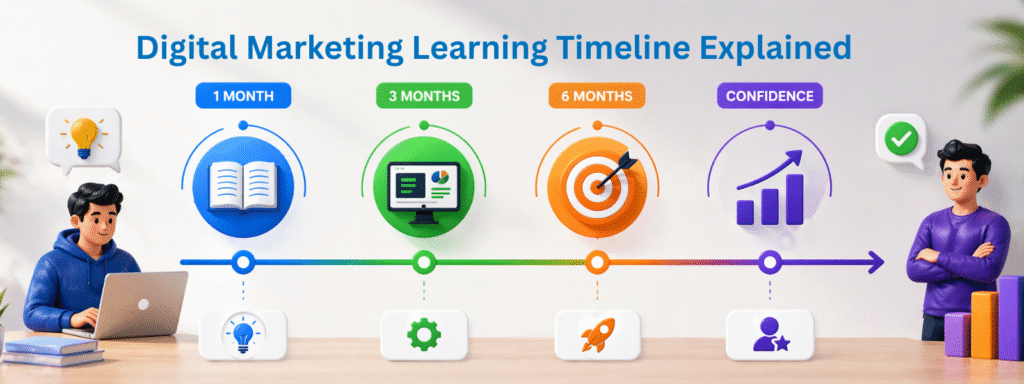
It typically takes 3 to 6 months to learn digital marketing basics with proper guidance.
However:
- Understanding concepts → a few weeks
- Building real skills → 2–3 months
- Gaining confidence → 3–6 months
- Becoming advanced → ongoing learning
The timeline depends more on your learning approach and consistency than just time.
Why There Is No One Fixed Timeline?
Digital marketing is not a single subject.
It’s a combination of skills like:
- SEO
- Social media marketing
- Advertising
- Content creation
- Analytics
Because of this, learning is not linear.
Some people understand concepts quickly but struggle to apply them. Others take time initially but become strong practically.
So instead of asking “how fast can I finish?”, the better question is:
“How well can I understand and apply it?”
Stage 1: Understanding the Basics (2–4 Weeks)
This is where most beginners start.
You begin learning:
- What digital marketing is
- How Google works
- What SEO means
- What ads and social media do
At this stage, everything feels interesting. But also slightly confusing. Because you are seeing many new terms for the first time. Not sure where to begin? Start here: what should you learn first in digital marketing
Real Scenario
A student watches YouTube videos or attends initial classes. They understand concepts like keywords or ads. But if you ask them to apply it — they hesitate. That’s normal. Because this stage is about exposure, not mastery.
Stage 2: Learning Individual Skills (1–2 Months)
Now things get more practical.
You start focusing on specific areas like:
- Writing content
- Understanding keywords
- Learning ad basics
- Creating simple strategies
This is where clarity starts building. But also where most people feel stuck. Following a proper sequence makes learning easier: right order to learn digital marketing modules
Why People Get Stuck Here?
Because they:
- Learn randomly
- Jump between topics
- Don’t follow a structured path
This leads to confusion like:
“I know everything… but I can’t do anything properly.”
This is the most critical stage.
Stage 3: Practical Application (2–3 Months)
This is where real learning happens.
You start:
- Applying SEO on websites
- Understanding how ads actually perform
- Observing results
- Making small improvements
Now digital marketing starts making sense. Not as theory — but as a system.
Example
Instead of just learning “SEO improves ranking,”
you understand:
- Why a page is ranking
- What changes improve visibility
- How users interact with content
This is where confidence begins.
Stage 4: Building Confidence (3–6 Months)
At this stage, you stop feeling like a beginner.
You can:
- Understand problems
- Suggest solutions
- Execute basic strategies
You may not be an expert yet, but you are no longer confused.
This is the stage where:
- Students start freelancing
- Beginners apply for jobs
- Business owners start managing their marketing better
What Actually Affects Your Learning Speed?
Two people can spend the same time learning — but get completely different results. Because learning speed depends on:
Learning Approach
Random videos vs structured learning makes a huge difference. Structured learning saves time and reduces confusion.
Practice vs Theory
If you only watch or read, learning feels slow. If you apply, learning becomes faster.
Consistency
Learning 1 hour daily is better than learning 5 hours once a week. Consistency builds understanding.
Guidance
Without guidance, beginners often:
- Overthink
- Skip fundamentals
- Focus on tools instead of concepts
With guidance, learning becomes smoother.
Common Misconceptions About Learning Digital Marketing
Many beginners start with wrong expectations. Let’s clear a few. Worried about technical skills? Read:can you learn digital marketing without technical background
“I can learn everything in 1 month”
You can understand basics in 1 month. But real skill needs time and practice.
“I need to learn all tools first”
Tools are secondary. Understanding comes first.
“More courses = better learning”
More content often creates more confusion. Clarity comes from structured learning.
Real Comparison: Fast vs Effective Learning
Let’s look at two common approaches.
Person A (Fast but Random)
- Watches many videos
- Learns bits of everything
- No structure
- No practice
Result: Confused after 3 months
Person B (Structured Learning)
- Follows a step-by-step approach
- Focuses on one concept at a time
- Applies learning
- Gets guidance
Result: Confident in 3–4 months
Same time. Completely different outcome.
So, How Long Should YOU Expect?
Let’s simplify this based on goals.
If your goal is understanding basics
1 month is enough
If your goal is skill development
3 months is realistic
If your goal is confidence + career
4 to 6 months is ideal
There is no shortcut. But there is a clear path.
Common Mistakes That Slow Down Learning
Many students unknowingly delay their progress.
They:
- Try to learn everything at once
- Focus only on tools
- Avoid practice
- Don’t follow a sequence
These mistakes don’t stop learning. But they slow it down significantly.
What Makes Learning Faster and Better?
Instead of rushing, focus on clarity.
Learning becomes faster when:
- Concepts are understood properly
- Practice is included
- Learning is structured
- Doubts are resolved early
Speed comes from clarity, not shortcuts.
Final Thought
Digital marketing is not something you “complete.”
It’s something you grow into. The real goal is not finishing a course.
The real goal is:
- Understanding how things work
- Applying them confidently
- Improving with experience
Once that starts happening, time stops feeling like a problem.
Want to Learn Digital Marketing Without Confusion?
If you want to learn digital marketing in a structured, practical way — guidance can save you months of confusion.
Instead of learning randomly, following a clear path helps you build real understanding step by step.
You can explore our digital marketing course in Jalandhar designed for beginners who want clarity, not just information.
Start Learning Digital Marketing the Right Way
If you’re serious about learning digital marketing the right way, don’t focus on speed — focus on clarity.
A structured approach can save months of confusion and help you build real skills. Explore our digital marketing course in Jalandhar and start your journey with the right direction.
Frequently Asked Questions
It usually takes 3 to 6 months to learn digital marketing basics with proper guidance. Understanding concepts may take a few weeks, but building real skills requires consistent practice.
Yes, digital marketing is beginner-friendly. It does not require a technical background, but consistency and practice are important for better understanding.
You can understand basic concepts in 1 month, but practical skills and confidence take more time. Real learning happens when you start applying what you learn.
No, coding is not required. Basic computer knowledge and willingness to learn are enough to get started in digital marketing.
Yes, you can start applying for jobs after 3 months if you have practical skills and understanding. However, confidence improves with more practice and experience.
The fastest way is to follow a structured learning path, focus on one topic at a time, and apply concepts practically instead of only watching tutorials.
Studying 1–2 hours daily with consistency is enough for steady progress. Regular practice is more important than studying for long hours occasionally.